
Your Cart is Empty
Shop confidently - 14-day no-hassle return policy
Shop confidently - 14-day no-hassle return policy

If you’re Googling “S Corp vs LLC” at 10:47 pm with 27 tabs open … hi. We see you.
You’ve probably hit that point in your business where:
Revenue is growing
Your CPA mentioned (or you saw someone on Instagram mention) S Corp status
You’re tired of paying so much in self-employment taxes
First of all? That’s a power move.

Electing S Corp status can absolutely be a smart next step. For many online business owners, an S Corporation helps reduce tax liability and create a more strategic compensation structure.
But here’s what we want you to understand as you go to file the paperwork:
An S Corp is strong protection.
It’s just not complete protection.
And confusing the two is where people get burned.
Let’s give credit where credit is due.
Electing S Corporation status can:
Potentially lower self-employment taxes
Force you to pay yourself a reasonable salary
Separate business income from personal income (structurally)
Create more formal business systems
For profitable online business owners, this can make serious financial sense.
It signals: I’m not playing small anymore.
But here’s the mental shift most people miss:
An S Corp primarily solves a tax strategy problem.
It doesn’t solve a risk exposure problem.
Still deciding between an LLC and an S Corp status? This blog post will help.
We’ve seen this pattern more times than we can count.
A business owner elects S Corporation status, pats themself on the back for a job well done, and continues on.
Because electing S Corp status feels like crossing a finish line.
You filed paperwork.
You talked to your CPA.
You updated payroll.
You’re “official” now.
There’s a subtle psychological shift that happens, and you start to think, “Okay, I’m protected now”.
Because the first real test of your business structure won’t be a tax audit.
It’ll be something far more ordinary.
A client who insists on a fifth re-work.
The refund request that feels manipulative.
The contractor who casually says, “Oh, I own that.”
The stranger who repackages your digital product and calls it inspiration.
None of those situations care about your S Corporation status.
They care about what’s written.
What was agreed to.
What boundaries were set.
Your entity structure is one layer.
Your contracts, terms and conditions, and trademarks are another.

Here’s what many online business owners learn too late:
An S Corp protects your entity.
Contracts protect your operations.
And most online disputes are operational.
They’re not about tax treatment.
They’re about expectations.
And if those expectations only live in your inbox or worse, in your head …
You’re exposed.
Not because you chose the wrong structure.
But because you stopped at the structure.
If you’re serious enough to elect S Corporation status, here’s what your protection stack should look like:
Separates business and personal (when maintained properly)
Optimizes tax strategy
Want a hot take? Here are 7 Reasons NOT to File an LLC
Defines scope and deliverables
Establishes refund rules
Protects intellectual property
Sets payment terms
Clarifies contractor relationships
Don’t forget these 7 things in your contracts
Separate bank accounts
Clear recordkeeping
Consistent contract updates
How to keep your contracts up to date
S Corp status is foundational.
Contracts are functional.
One without the other leaves gaps.
If you’re researching S Corp elections, it likely means:
You’re profitable
You’re scaling
You’re hiring
You’re launching more offers
Growth increases exposure.
More revenue = more eyes on your business
More clients = more potential disputes
More contractors = more complexity
The solution is to make sure your legal protection grows with your revenue.
An S Corp is a smart, strategic move.
It can save you money.
It can create structure.
It can level up your business.
But it won’t:
Stop refund abuse
Prevent chargebacks
Fix vague agreements
Protect your IP by itself
Manager contractor expectations
Think of your S Corporation status as the frame of the house.
Your contracts? They’re the locks on the doors.
And you’d never want to leave your house unlocked while you slept.
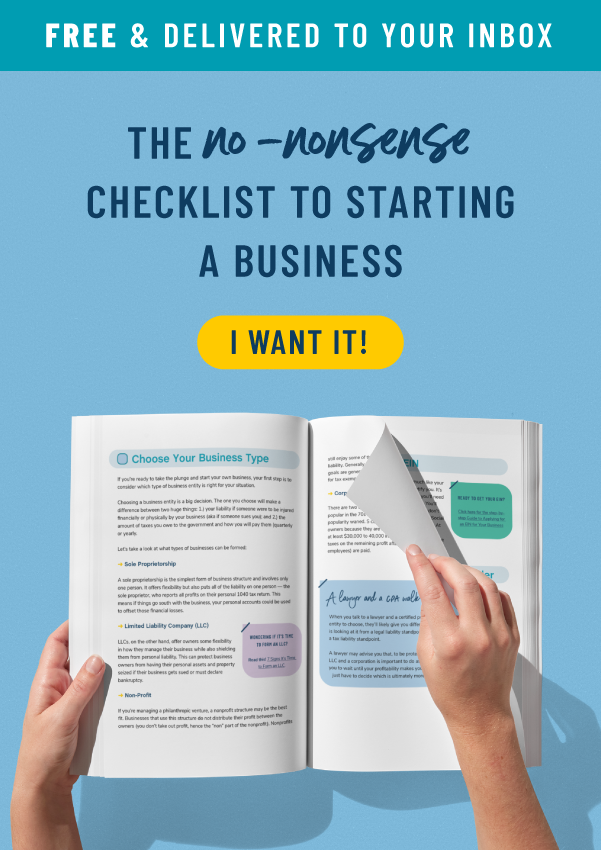
So, while you’re doing the work to protect your business, use our No-Nonsense Checklist to Starting a Business to make sure your entire protection stack is in place. Download it for free here.

Comments will be approved before showing up.

Ready to register a business? Here’s exactly how to register your business name, structure, EIN, and licenses, step by step.

Learn how to get a copyright step-by-step, why it matters, and how to protect your work as a small business owner, without the legal overwhelm.

If this is the year you want to simplify your marketing and spend less time and effort without losing results, it’s time to learn about Pinterest marketing.