
Your Cart is Empty
Shop confidently - 14-day no-hassle return policy
Shop confidently - 14-day no-hassle return policy

If you’ve ever Googled “how to get a copyright” at 11:47 pm while panic-scrolling after someone liked your content a little too aggressively … hi, welcome. You’re in the right place. Let’s break this down in a no-nonsense, small business owner-friendly way because protecting your work shouldn’t feel like decoding ancient legal scrolls. Whether you’re a photographer, content creator, course seller, service provider, or digital product wizard, understanding copyright is one of those foundational “legal-ish” things that can save you a lot of stress later.
Technically, you already own a copyright the moment you create something original.
Yup. The second your idea leaves your brain and becomes tangible (like a blog post, course material, graphic, or caption), it’s protected. If you wrote it? You own it. If you designed it? You own it. If you recorded it? You own it.
No paperwork required …yet.
This is often misunderstood because it seems too simple. With copyright law, you don't need to apply for ownership; it’s automatic. Unlike a trademark (you must apply for ownership of one of those). But (and this is a big but), automatic protection is not the same thing as strong protection.

So why do people register a copyright? Because “technically protected” and “legally enforceable” are two very different vibes. Without registration, proving ownership and taking action against someone who copies your work becomes significantly harder. With registration, you’ve got the receipts.
Registering your copyright gives you:
Proof of ownership
If someone copies your work, you don’t have to scramble to prove it’s yours. It’s already documented.
The ability to sue for damages
Without registration, your options are limited. With it, you can pursue legal remedies if needed.
Stronger legal standing
If things get messy (and sometimes they do), registration gives you leverage.
Basically, it turns your “hey, that’s mine” into “hey, that’s mine, and I can back it up.” And when your business relies on your ideas, content, and creations? That backup matters.
Let’s walk through this checklist-style so you can follow along (and finish).
Before you do anything else, make sure what you’re trying to protect actually qualifies for copyright.
Copyright protects original works of authorship, like:
Written content (blog posts, ebooks, course materials)
Visuals (graphics, photos)
Audio/video (podcasts, reels, courses)
It does not protect:
Ideas (sorry, billion-dollar app concept)
Systems or processes
Names or slogans (that’s trademark territory)
Just to be clear, if you’re wondering, “how to copyright a business name”, you’re actually looking for a trademark, not a copyright. This blog post covers how to trademark your business name.

If you’re in the United States, you’ll register your copyright through the U.S. Copyright Office.
You’ll create an account and complete an online application. The process is fairly straightforward and doesn’t require a lawyer for most basic filings.
During the application, you’ll:
Select the type of work you’re registering
Enter details about the creator (aka, you!!)
Provide information about when the work was created and published
Next, you’ll upload a copy of your work, also known as a “deposit”, and it becomes part of the official record. Depending on what you’re registering, this could be:
A PDF of your ebook
A file of your course materials
An image or design file
Fees typically range from $45-$85 depending on the type of application. Is it the most exciting way to spend your hard-earned revenue? No. But it is one of the smartest ways you can. When you consider the time, effort, and creativity that went into your work, this is a relatively small investment for peace of mind.
Once everything is submitted, you’ll wait. Processing times can vary, but it often takes a few months for your registration to be finalized. The good news? Your protection is tied to your submission date, not when it’s approved, so you’re covered while you wait.
A copyright is powerful, but it is just one piece of protection for your business. It doesn’t:
Monitor the internet for people copying your work
Automatically stop people from copying you
Tell clients or customers how they can use your content
Protect your website, customer data, or business operations
Which means, if you’re creating content, selling digital products, or running an online business, you also need:
These outline how people can use your website, content, and products
This explains how you collect, use, and store customer data (and yes, you need one even if you’re “just” collecting emails)
This is where you define who owns what, how your work can be used, what happens if boundaries are crossed, and more.
Because while getting a copyright isn’t complicated, the goal isn’t just to have some protection, but to build a business that’s legally solid from day one. Most business owners think about legal protection as something they deal withaftersomething goes wrong. But we want to make sure that we’ve done all we can to stop problems from happening in the first place.
Clear expectations, defined boundaries, and solid legal foundations don’t just protect you, they make your business run smoother, feel more professional, and build trust with your clients and customers.
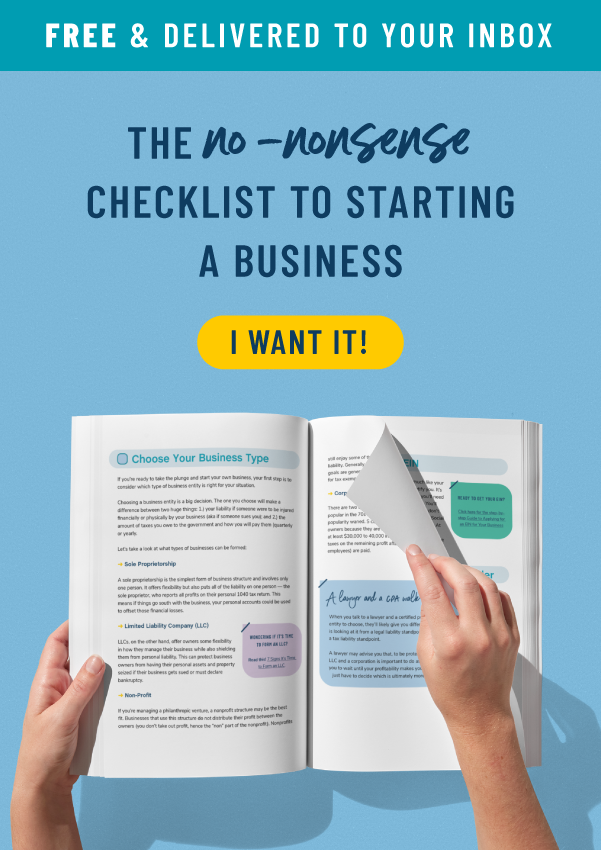
If you’re still figuring that part out, we can help. The next best step is to download our free No-Nonsense Checklist for Starting a Business. It’s going to walk you through all of the legal foundations you need to have in place to stay protected as a small business owner.


Comments will be approved before showing up.

Ready to register a business? Here’s exactly how to register your business name, structure, EIN, and licenses, step by step.

Electing S Corp status is a smart tax move, but it’s not complete protection. Discover the full protection stack you need for your online business.

If this is the year you want to simplify your marketing and spend less time and effort without losing results, it’s time to learn about Pinterest marketing.